Oven Repair
Viking Oven Bakes Pale and Slow: Altitude or Fault?
At 5,280 feet an oven that seems weak may be behaving exactly as physics says it should. Here is how to tell a real calibration fault from Denver's thin air, what to log, which parts actually fail, and when to call.
Written by
Clifford Nakamura
Service technician — controls and intermittent faults · 22 years in the trade
- Viking appliances
- intermittent electrical faults
- connector and harness repair
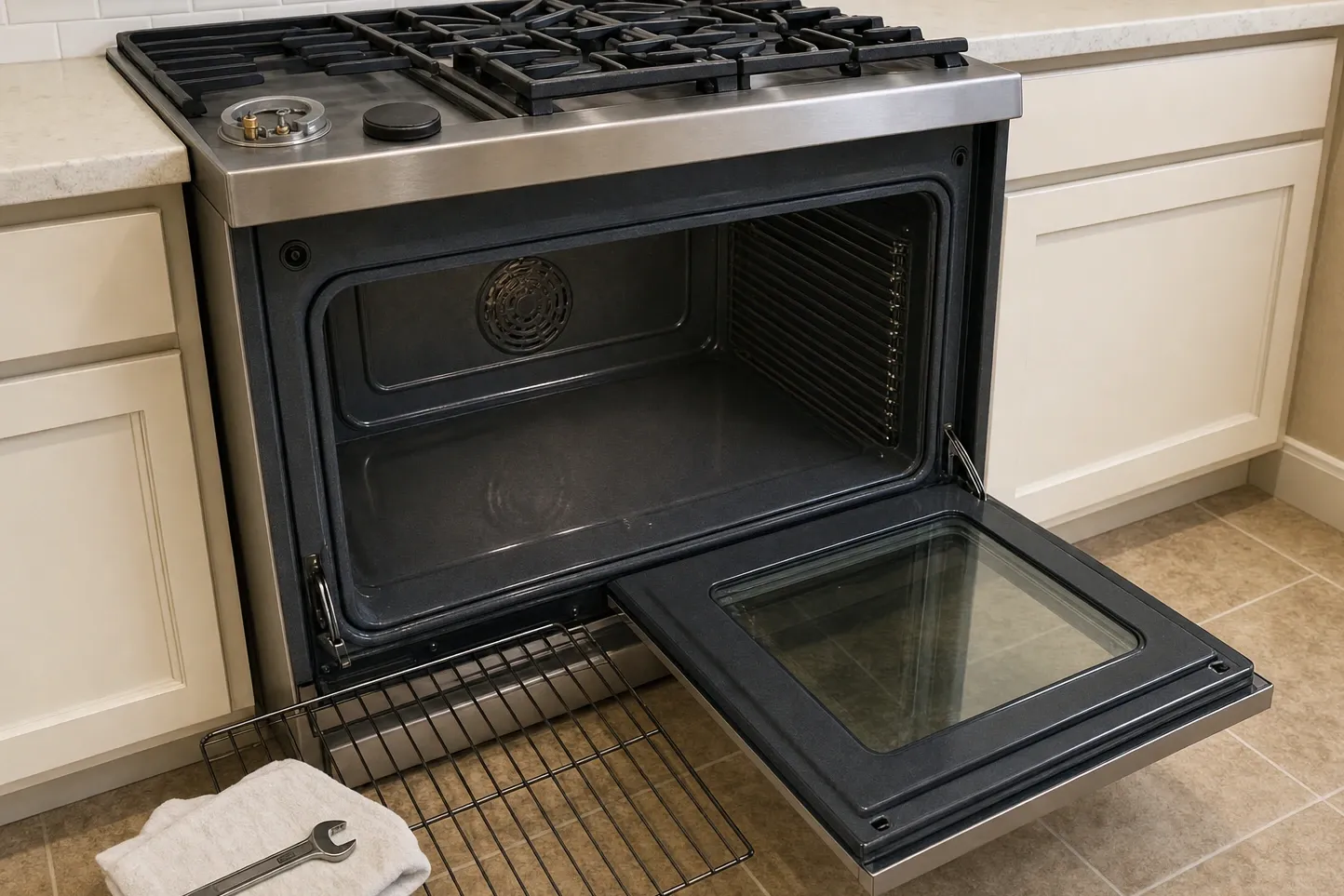
Cakes that stay pale, roasts that need another twenty minutes, bread that comes out heavy: on a Viking oven in Denver this is one symptom with two completely different explanations. One is a fault worth paying to fix. The other is the city you live in.
Both deserve a real answer before anyone starts replacing parts, because the diagnosis is cheap and the guesswork is not.
What altitude does to an oven that is working perfectly
At 5,280 feet the air is thinner and drier and water boils at about 202°F rather than 212°F. None of that changes what the oven heats to — but it changes what happens inside the food.
Leavening expands harder and earlier, so batters rise fast and then collapse before the structure has set: a cake that looks sunken and underdone in the middle. Moisture leaves the surface quicker, so a crust forms before the inside is cooked and browning lags behind cooking. Anything covered with liquid takes longer, because that liquid never gets as hot as it would at sea level.
The result reads exactly like a weak oven. If baking has been “off” since you moved here, or since you started using a recipe written elsewhere, altitude is the first suspect — and no part will fix it.
How to tell the difference in one afternoon
Test the oven, not the cake. Empty the cavity, set it to 350°F, and put a probe thermometer in the middle of the middle rack — not touching metal.
Then watch three things:
- Time to reach the setting. A working oven of this size should get there in fifteen to twenty-five minutes. Much longer with no obvious reason is a real finding.
- The average once it settles. Ovens cycle around a target; that is normal. Compare the average of the peaks and troughs against the setting, not the single highest number you see.
- The shape of the cycle. Gentle rise, gentle fall, repeating evenly is healthy. Sharp overshoot followed by a long dead drop is not, and it points somewhere specific.
If the average sits close to 350°F and the swing is modest, the oven is fine and the problem is the recipe. If the cavity is consistently well under the setting, or the swing is wild, that is a fault and the shape of it tells us which.
The parts that actually fail on these ovens
The temperature sensor. It is a resistance probe, and as it ages its readings walk away from reality. The control then holds the cavity at the wrong number faithfully. This is the classic “everything bakes pale” case, and it drifts slowly enough that people adapt for a year before calling.
A relay on the control board. The relay switches the element or the gas valve. When its contacts degrade it stops opening and closing crisply, and you get heat that overshoots and then falls away to nothing. On a logged cycle it looks like a square wave instead of a ripple.
The convection element or its fan. If the convection setting blows air that never gets hot, or the fan has stopped while the bake element still works, one half of the oven’s ability disappears. Food browns on one side and stays anaemic on the other.
The door: gasket, hinges, glass. Heat that leaks does not bake. A gasket gone hard and shrunken — and Denver’s dry air is unkind to gaskets — or hinges that no longer pull the door tight will cost real temperature at the top of the cavity without throwing any error at all.
The latch motor. Different symptom, same family: a door that stays locked after a self-clean cycle is a latch motor jammed on its track, not a control failure. Running self-clean cycles back to back is the fastest way to get there.
What to check before booking anyone
Do these first, because they cost nothing:
- Look at the gasket all the way round. Squeeze it. If it is hard, flattened or torn at a corner, that alone can explain a slow oven.
- Close the door on a strip of paper at several points. If it pulls out freely at the top, the hinges or the gasket are not sealing.
- Check whether one shelf position bakes worse than another. A single bad zone usually means airflow; the whole cavity being weak usually means calibration.
- Note whether the fault appears on bake, on convection, or on both. That single answer eliminates half the possibilities before anyone arrives.
- Have the model number ready. It decides which sensor and which control travel with us.
When it is worth calling
Call if the logged average is well under the setting, if the cycle overshoots and collapses, if convection blows cold, if the door will not seal, or if a clean cycle has locked the door shut. Those are parts-and-meter problems and they do not improve on their own.
Do not call if the oven holds its setting properly and the disappointment is in the baking. Adjust the recipe instead: a little less leavening, a slightly hotter oven, a touch more liquid, and pans in the middle of the cavity. That is not a repair, and we will say so on the phone rather than come out and charge you to confirm your oven is fine.
The useful line to hold on to: an oven either holds temperature or it does not, and that question is answerable with a probe in an afternoon. Everything else is cooking at altitude, which every kitchen in this city has to live with.
Follow-up questions
How far off can an oven be before it is worth fixing?
A cavity that averages fifteen to twenty degrees under the setting across a full cycle is worth correcting — that is the difference between a sponge that sets and one that sinks. Swings of forty degrees either side of the target, or a cavity that never reaches the setting at all, are faults rather than drift.
Is an oven thermometer from the supermarket good enough to test with?
It is good enough to tell you something is wrong. It is not good enough to say what: a dial thermometer reads the air near itself, lags badly, and cannot show you the shape of the cycle. For the actual diagnosis we log the cavity with a probe over a full heat-up and several cycles.
Can I just turn the temperature up and carry on?
For a while, yes, and plenty of people do. The catch is that a failing sensor keeps drifting, so the offset you learn this month is wrong next month — and if the cause is a relay rather than the sensor, the swings get worse regardless of what you set.